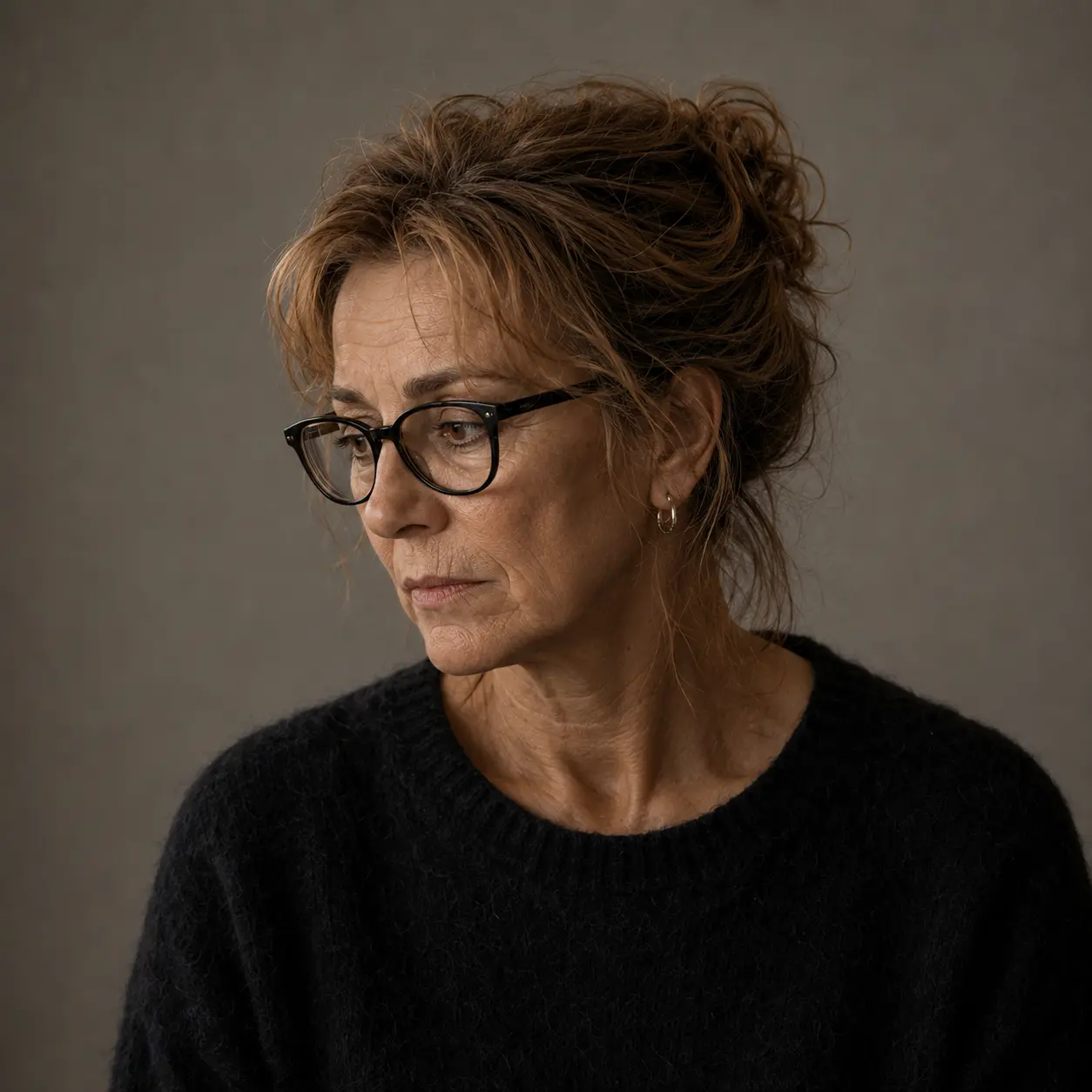
Sofia · The Translator
The Fidelity
of Uncertainty
Sofia knows that every translation is a promise made with imperfect means: to carry a meaning across without pretending nothing changed in the crossing.
She listens to words as other people listen to confessions. Not only for what they declare, but for register, hesitation and the pressure of what has been withheld. A sentence is never merely its information. It contains a speaker, a history and an imagined listener. Sofia's gift is to hear all three before choosing how the sentence will live again.
This attention makes her exacting. She distrusts the convenient equivalent, the polished phrase that arrives too quickly and the confidence that hides a loss. Where another reader sees one obvious meaning, Sofia sees the meanings that had to be refused to produce it. Her precision is not pedantry. It is respect for everything a word was capable of before a choice narrowed it.
Yet the same sensitivity can become a refuge. If every expression contains alternatives, a decision can always be postponed in the name of care. Sofia is skilled at remaining among possibilities, where no single version has yet become her responsibility. She can describe the distance between two meanings with greater ease than she can admit which one she needs.
Translation exposes the limits of that refuge. A translator must eventually place one word on the page. The choice may be informed by grammar, rhythm, context and instinct, but it cannot be made impersonal. Sofia would like fidelity to mean that the self disappears from the work. Experience teaches her the opposite: fidelity begins when the self becomes accountable for what it has altered.
This is why certainty troubles her. Certainty can make a version look innocent, as though the other possibilities never existed. Sofia's deeper discipline is to resist that innocence. She does not preserve ambiguity because she fears judgment. She preserves it when judgment would erase a genuine tension—when two meanings belong beside one another because each carries a different responsibility toward the past.
She is capable of sharpness, especially when someone treats language as a container that can be emptied without residue. Afterwards she may regret the edge of her words without withdrawing their truth. This is one of her least comfortable contradictions: tact matters to her, but accuracy matters more, and she cannot always keep one from wounding the other.
Her growth is not a movement from uncertainty to assurance. It is the recognition that uncertainty does not absolve her from choosing. A note, a heading, a single verb: each can acknowledge both the limits of translation and the presence of the translator. To name her part in the decision is not to claim ownership of the original. It is to stop disguising interpretation as inevitability.
Sofia's finest fidelity is therefore not to sameness, which no language can guarantee. It is to the fragile difference between what remained and what stayed, between endurance and choice, between the meaning received and the meaning made. She lets both stand long enough to be heard. Then she chooses a word—and leaves the door open to the one beside it.