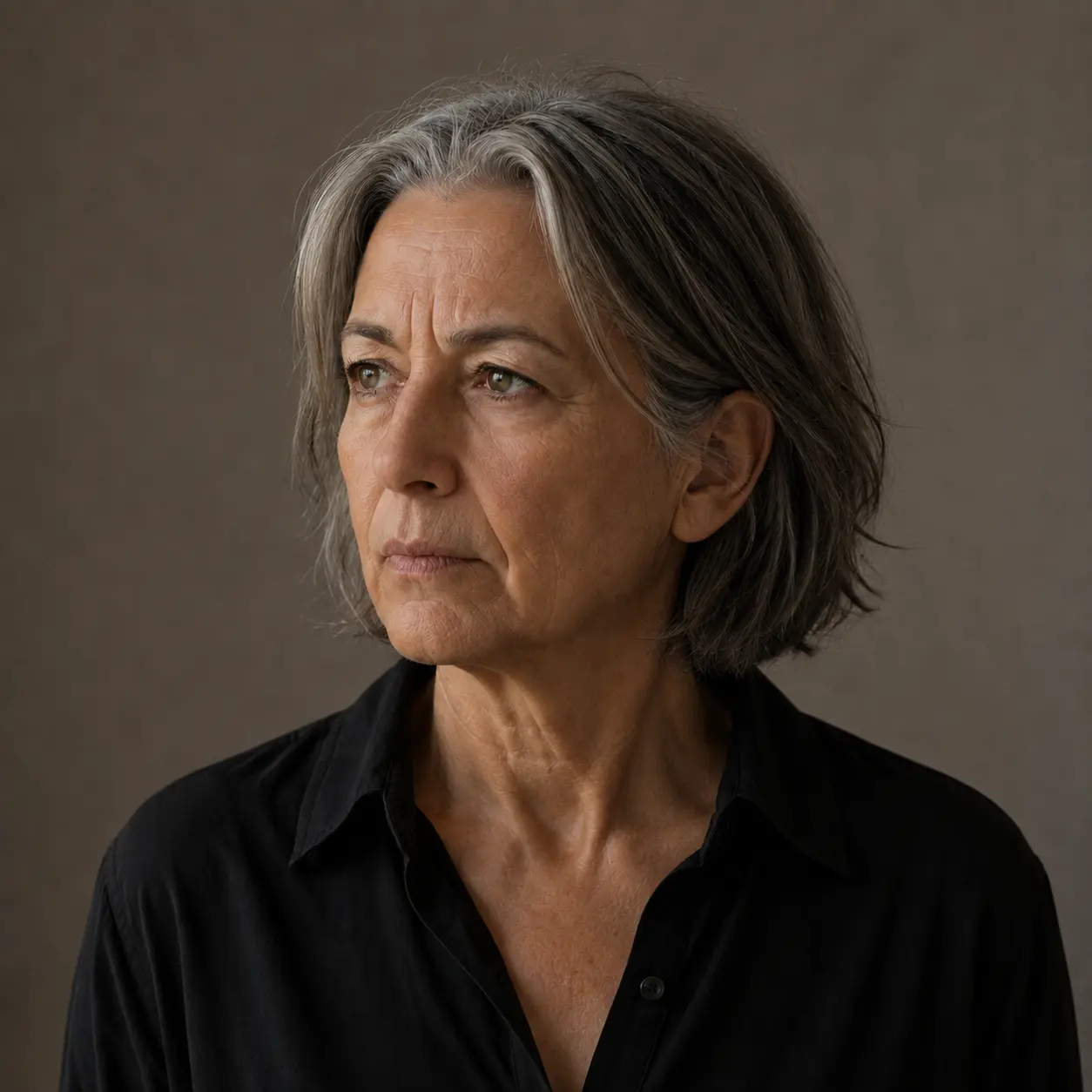
Eleanor · The Painter
What the Eye
Cannot Hold
Eleanor has built a life on the belief that looking carefully is a form of honesty. Her difficulty begins when she mistakes honesty for completeness.
She notices what most people edit out. The hesitation before a face settles into politeness. The unequal pressure of two hands resting on a chair. The small withdrawal that occurs while the body remains exactly where it was. Eleanor's gift is not simply accuracy. It is an attention patient enough to wait for contradiction to appear.
This is why her portraits feel intimate. She does not paint the expression a person offers first, or the story that expression has been trained to support. She stays with the face until certainty begins to loosen. Linen, light, distance, the pressure of a brush: these are not merely materials to her. They are ways of asking a question without forcing the subject to answer aloud.
Yet the same attention that allows Eleanor to see so much can persuade her that she has understood more than anyone is entitled to understand. Observation becomes authority. A captured gesture begins to look like evidence; a choice of colour, like a conclusion. She knows that every portrait is an interpretation, but part of her still longs for the interpretation that will make all the others unnecessary.
Control is the quiet architecture of her life. It can be found in the obsolete brushes she refuses to discard, in the exact position of a canvas, in the silence she keeps until speech can no longer surprise her. Work gives uncertainty a surface and an edge. It lets her decide where the light falls. What she can render, she can contain—or so she is sometimes tempted to believe.
This temptation is strongest when memory enters the studio. Eleanor can imagine that a different image might have produced a different future: that another emphasis, another omission, another act of courage with the brush could have changed what followed. There is grief in this belief, but pride as well. It grants the painter a power no painter possesses. A portrait may alter how a life is remembered. It cannot govern the life itself.
Time makes this impossible power harder to surrender. When two honest images of the same person refuse to agree, the eye searches instinctively for the truer one. Eleanor's deepest instinct is to choose, to revise, to decide which vision deserves to remain. But a later likeness does not correct an earlier one. An earlier intimacy does not invalidate what time eventually reveals. Both may be sincere. Neither is complete.
Her growth lies in resisting the final explanation. This is more difficult for her than disclosure. To show something without telling others how to understand it means relinquishing the privilege of the artist who stands beside the work and names its meaning. It means accepting that viewers will bring their own memories, their own loyalties, their own errors—and that the image will live among interpretations she cannot control.
Eleanor does not stop looking closely. She does not become less exact, less private, or less demanding of the work. She learns instead to leave room around what she sees. The finest portrait is not the one that imprisons a life inside a single expression. It is the one that preserves the mystery of everything the face could not, in that moment, reveal.